Clinical Case Studies
The clinical images and case descriptions on this page are provided for general educational purposes only and are not intended to imply any specific treatment outcome. Every patient is different, and individual results will vary depending on diagnosis, treatment plan, age, biology, patient cooperation, and retention compliance. These cases do not represent typical or guaranteed outcomes. All images have been published with patient consent.
Managing Dental Spacing
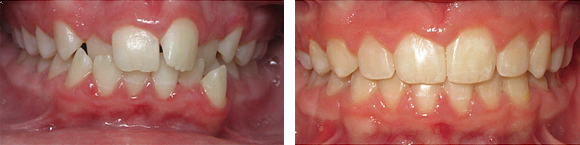
Clinical Case: Orthodontic Management of Generalised Dental Spacing
Patient Presentation: This patient presented with generalised spacing across both the upper and lower dental arches. As the permanent dentition was established, spacing became more pronounced. A consultation was sought to assess long-term management options for space distribution and oral health.
Treatment Approach: A fixed appliance (braces) was used to guide the teeth into a more functional alignment over a 21-month period. The treatment focused on closing spaces and managing the occlusion to support long-term dental and oral health. Results were specific to this patient’s individual presentation.
Managing an Underbite with Impacted Canines

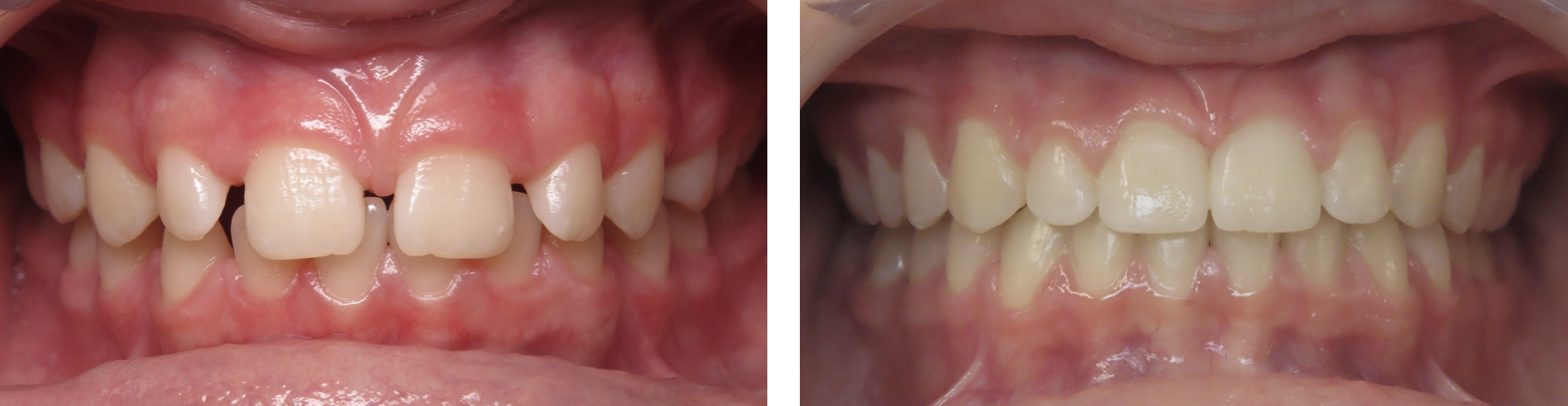
Clinical Case: Skeletal Underbite with Bilaterally Impacted Upper Canines
Patient Presentation: This patient presented with a skeletal Class III tendency (underbite), where the lower anterior teeth were occluding in front of the upper teeth. A narrow upper arch had contributed to bilateral impaction of the maxillary canines, which were unable to erupt into the arch naturally.
Treatment Approach: A non-extraction treatment plan was developed. Upper arch expansion was used to address the transverse deficiency and create space within the arch. Fixed appliances were then used to facilitate eruption of the impacted canines and manage the anterior crossbite. Treatment was completed over a 24-month period. Results were specific to this patient’s individual presentation and clinical circumstances.
Clinical Case: Skeletal Underbite with Bilaterally Impacted Upper Canines — Detailed Case Notes
Case Overview: A 24-month non-extraction orthodontic treatment plan for a teenage patient.
Patient Presentation: This patient presented with a skeletal Class III tendency (underbite), where the lower anterior teeth were occluding in front of the upper teeth. A narrow upper arch had resulted in bilateral impaction of the maxillary canines, which were unable to erupt into position naturally.
Treatment Approach: A non-extraction treatment plan was developed. Upper arch expansion was used to address the transverse deficiency and create space within the arch. Fixed appliances were then used to facilitate eruption of the impacted canines and manage the anterior crossbite. Treatment was completed over a 24-month period. Results were specific to this patient’s individual presentation and clinical circumstances.